The 8th Conference of Leaders of Religions in Astana: A Message of Peace for the World Kazakhstan… A Bridge Connecting Nations and Embracing Different Cultures

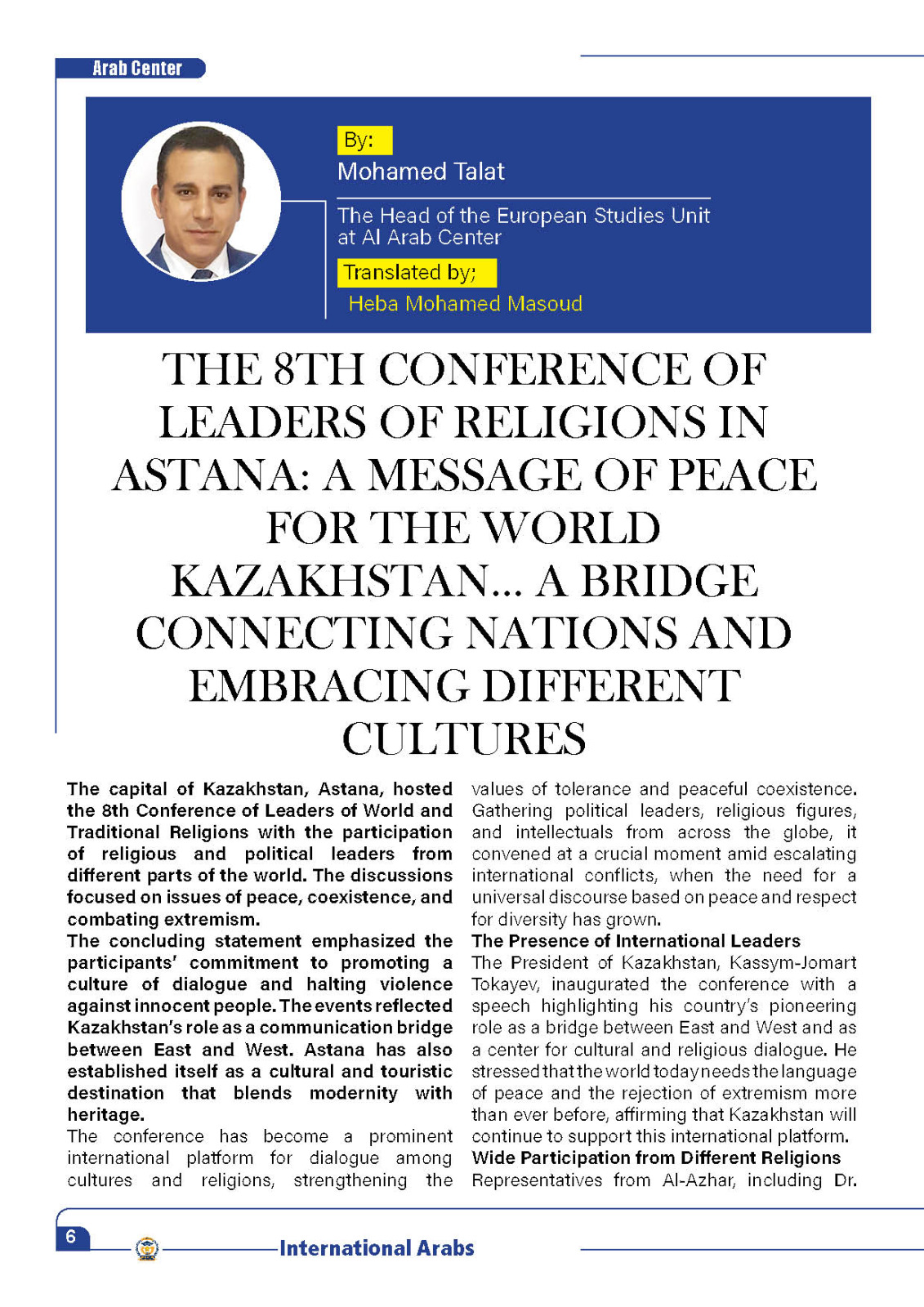
By: Mohamed Talat
Translated by: Heba Mohamed Masoud
The capital of Kazakhstan, Astana, hosted the 8th Conference of Leaders of World and Traditional Religions with the participation of religious and political leaders from different parts of the world. The discussions focused on issues of peace, coexistence, and combating extremism.
The concluding statement emphasized the participants’ commitment to promoting a culture of dialogue and halting violence against innocent people. The events reflected Kazakhstan’s role as a communication bridge between East and West. Astana has also established itself as a cultural and touristic destination that blends modernity with heritage.
The conference has become a prominent international platform for dialogue among cultures and religions, strengthening the values of tolerance and peaceful coexistence. Gathering political leaders, religious figures, and intellectuals from across the globe, it convened at a crucial moment amid escalating international conflicts, when the need for a universal discourse based on peace and respect for diversity has grown.
The Presence of International Leaders
The President of Kazakhstan, Kassym-Jomart Tokayev, inaugurated the conference with a speech highlighting his country’s pioneering role as a bridge between East and West and as a center for cultural and religious dialogue. He stressed that the world today needs the language of peace and the rejection of extremism more than ever before, affirming that Kazakhstan will continue to support this international platform.
Wide Participation from Different Religions
Representatives from Al-Azhar, including Dr. Osama Al-Azhari, and Dr. Nazir Aiad, the Grand Mufti of Egypt, joined the conference, alongside the Minister of Endowments. Participants also included representatives of the Vatican, rabbis of the Jewish faith, leaders of the Orthodox and Catholic Churches, as well as leaders of other religions such as Buddhism and Hinduism.
This diversity reflected the international nature of the conference and emphasized that it is not exclusive to any single religion or culture.
Discussions and Working Sessions
The sessions addressed several key themes. Among the most prominent were:
The role of religions in supporting social justice, mechanisms to combat extremism and terrorism. protection of human rights, addressing climate change and protecting the environment and the role of youth in spreading a culture of peace through digital media, given the growing influence of new communication platforms.
The Concluding Statement: A Call for Peace and Coexistence
At the end of the conference, participants issued a statement reaffirming their commitment to fostering dialogue among followers of different religions and civilizations. They also denounced all forms of violence and discrimination, calling for an end to attacks on innocent people in conflict zones. The statement urged efforts to build a more just and secure world that guarantees human dignity without discrimination.
International Reactions
The conference was widely welcomed by the international community. Both the United Nations and the European Union praised the initiative for its contribution to global stability. Experts noted that the event has become one of the most significant platforms for interfaith dialogue, standing alongside similar initiatives in the Middle East and Europe.
The Egyptian Dimension in the Conference
The participation of Al-Azhar and the Ministry of Endowments was particularly remarkable. The Egyptian delegation emphasized that Islam is a religion of peace and tolerance, calling for extremist ideologies to be confronted with knowledge and enlightened discourse. Their contribution was widely praised, with many participants recognizing Egypt as a true religious and cultural beacon in the Islamic world.
Astana: A City Blending Modernity and Tradition
It is impossible to speak about the conference without mentioning Kazakhstan’s capital, Astana, which hosted the event with excellent organization. Astana is considered one of the fastest-growing capitals in Central Asia and is renowned for its unique architecture, bridges, and landmarks that reflect a spirit of openness and development.
The Most Prominent Landmarks in Astana
Astana is home to several distinctive landmarks that make it a rising destination on the international tourism map, including:
Bayterek Tower: The city’s symbol, representing the Tree of Life., The Palace of Peace and Reconciliation: A pyramid-shaped building that hosts interfaith dialogue events. The Blue Mosque: The largest mosque in Central Asia.The Hazrat Sultan Mosque.Khan Shatyr Entertainment Center: The world’s largest transparent tent, housing shopping and entertainment facilities. The Independence Monument: A landmark symbolizing Kazakhstan’s modern history.
Cultural and Humanitarian Tourism
What distinguishes Astana is not only its modern urban planning but also its ability to combine traditional Kazakh identity with an international spirit. Alongside its high towers and wide streets, its people preserve their cultural heritage through music, art, and traditional cuisine, offering visitors a chance to explore the depth of Kazakh culture.
Conclusion
The 8th Conference of Leaders of World and Traditional Religions reaffirmed that dialogue is the best means of addressing common global challenges. From the heart of Astana, a strong message was sent to the world: coexistence is not merely a slogan, but a humanitarian choice to build a safer and more just future.
Once again, Kazakhstan has proven its ability to serve as a bridge that connects nations and embraces diverse cultures from around the globe.