A Majestic Reception and Wide Influence… Message of Peace Writes a New Chapter in Asia
Thousands of students interact with the ideas of Alshorafa Elhamadi, while academic partnerships open new horizons for international cooperation.
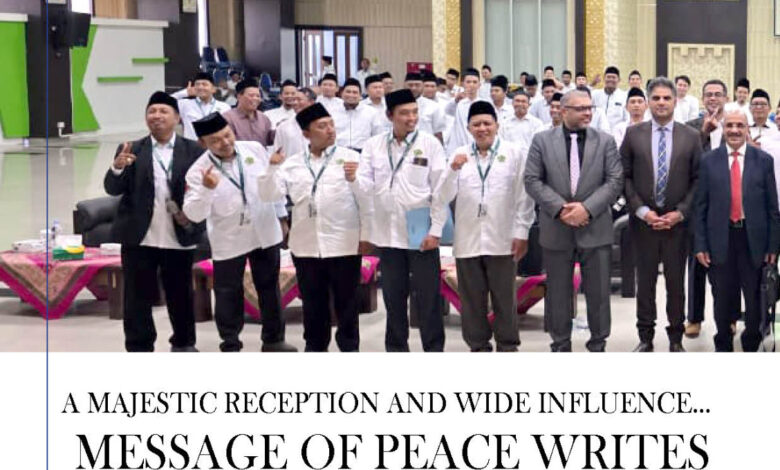
Jakarta – Al Arab Centre
A delegation from the Universal Peace Message has embarked on an Asian tour described as one of the most significant Arab intellectual movements toward East Asia. The tour aims to enhance cultural and da’wah presence and to build bridges of academic and humanitarian cooperation with educational institutions in Indonesia and Malaysia.
The delegation was headed by journalist Magdy Tantawy, the General Manager of the foundation, with the participation of an elite group of academics and media professionals. This comes within the framework of the intellectual project led by the Arab thinker Ali Mohamed ElShorafa Elhamadi, which is based on re-presenting Islamic discourse in its comprehensive Qur’anic form.
Formal Reception
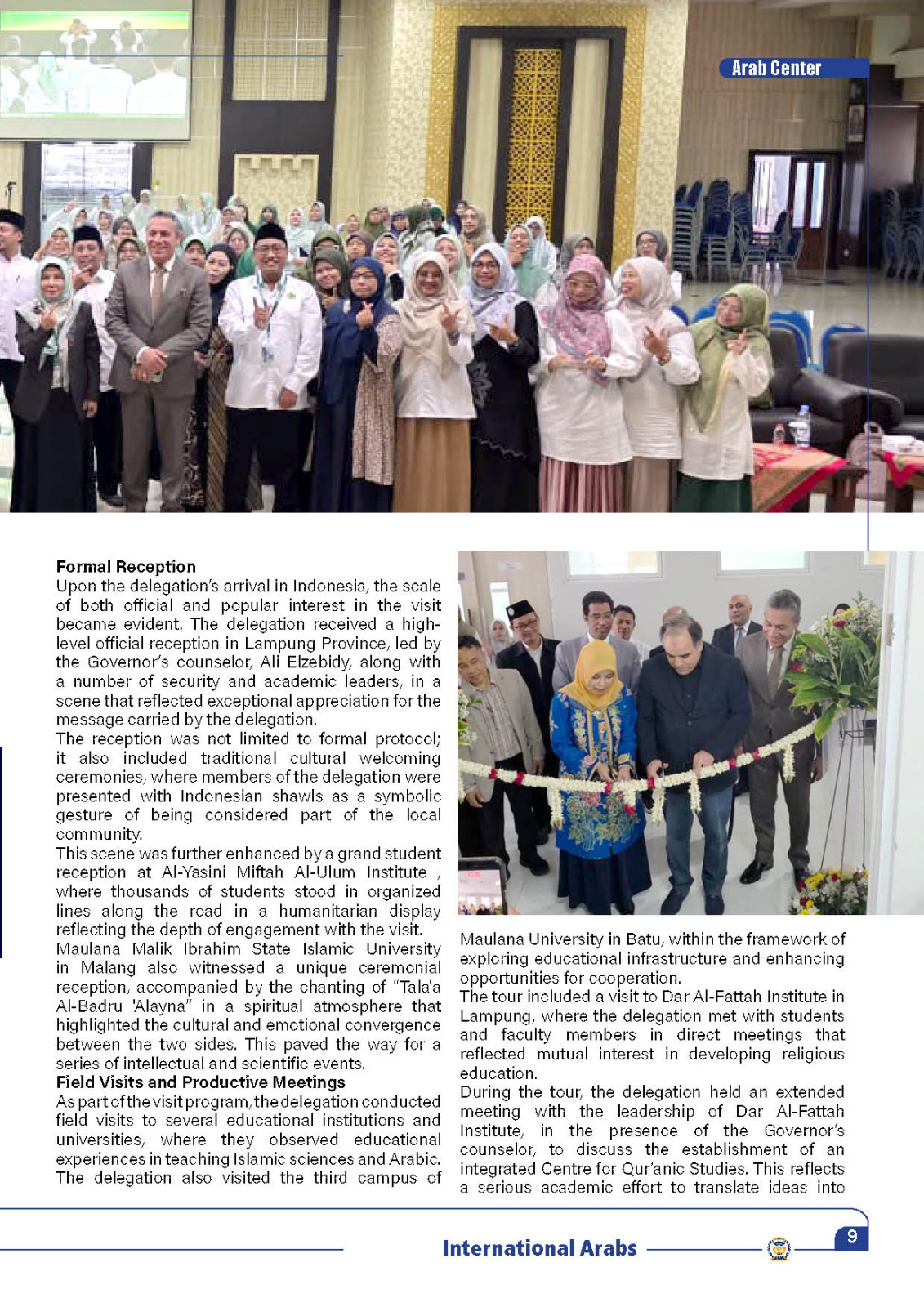
Upon the delegation’s arrival in Indonesia, the scale of both official and popular interest in the visit became evident. The delegation received a high-level official reception in Lampung Province, led by the Governor’s counselor, Ali Elzebidy, along with a number of security and academic leaders, in a scene that reflected exceptional appreciation for the message carried by the delegation.
The reception was not limited to formal protocol; it also included traditional cultural welcoming ceremonies, where members of the delegation were presented with Indonesian shawls as a symbolic gesture of being considered part of the local community.
This scene was further enhanced by a grand student reception at Al-Yasini Miftah Al-Ulum Institute , where thousands of students stood in organized lines along the road in a humanitarian display reflecting the depth of engagement with the visit.
Maulana Malik Ibrahim State Islamic University in Malang also witnessed a unique ceremonial reception, accompanied by the chanting of “Tala’a Al-Badru ‘Alayna” in a spiritual atmosphere that highlighted the cultural and emotional convergence between the two sides. This paved the way for a series of intellectual and scientific events.
Field Visits and Productive Meetings
As part of the visit program, the delegation conducted field visits to several educational institutions and universities, where they observed educational experiences in teaching Islamic sciences and Arabic. The delegation also visited the third campus of Maulana University in Batu, within the framework of exploring educational infrastructure and enhancing opportunities for cooperation.
The tour included a visit to Dar Al-Fattah Institute in Lampung, where the delegation met with students and faculty members in direct meetings that reflected mutual interest in developing religious education.
During the tour, the delegation held an extended meeting with the leadership of Dar Al-Fattah Institute, in the presence of the Governor’s counselor, to discuss the establishment of an integrated Centre for Qur’anic Studies. This reflects a serious academic effort to translate ideas into well-established educational institutions.
The visit also included an official meeting with the Governor of Lampung, who announced the allocation of approximately 80 feddans for the Universal Peace Foundation to establish a center and institute for Qur’anic studies—marking a significant step and a qualitative transformation in the path of cooperation.

Memorandum of Understanding Serving the “Message of Islam”
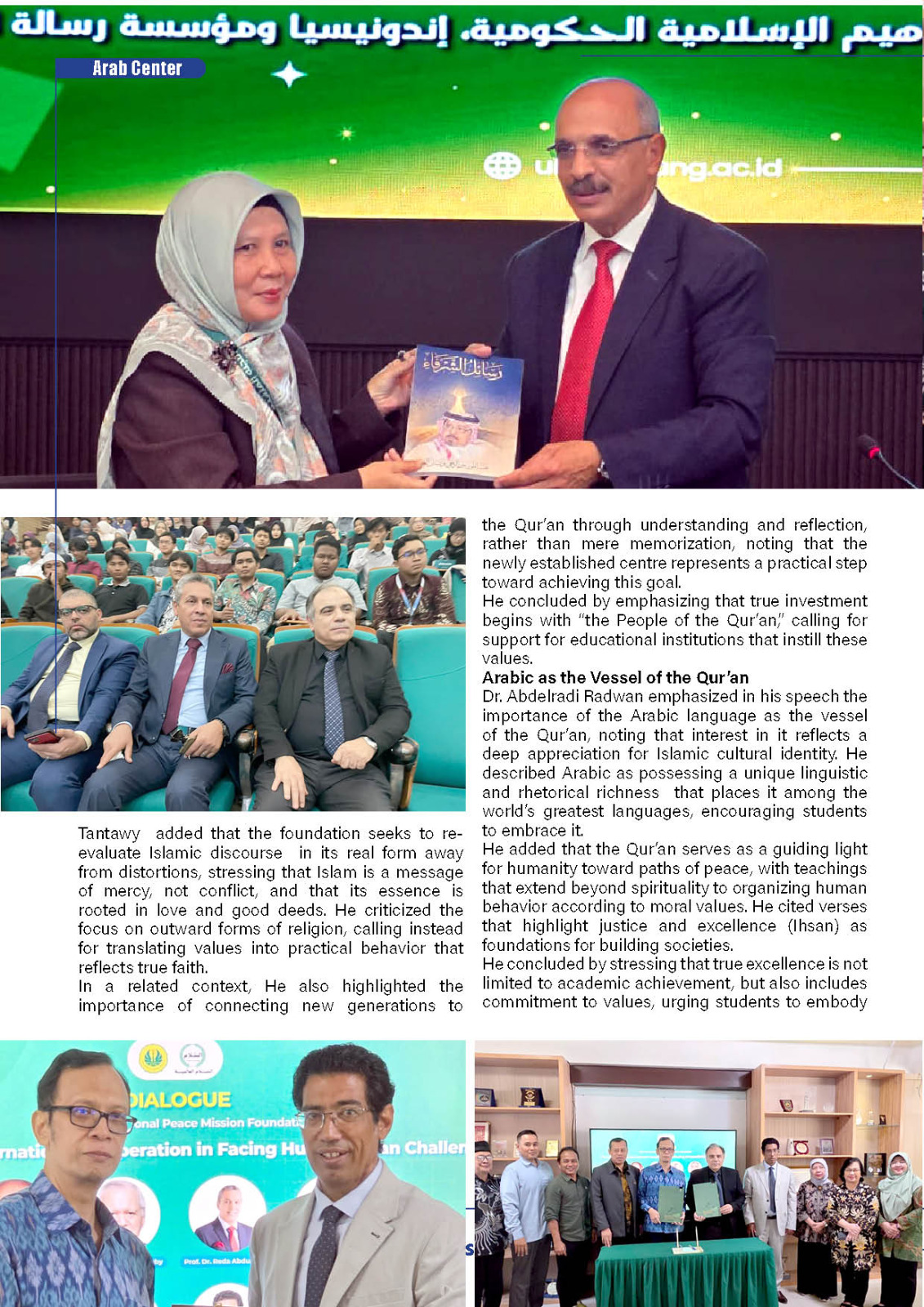
On the academic level, UIN Maulana Malik Ibrahim Malang witnessed the signing of a strategic Memorandum of Understanding with the Peace Message Foundation. The agreement aims to enhance cooperation in scientific research, as well as in teaching Arabic and Qur’anic studies
This cooperation was crowned by the inauguration of the AlShorafa Elhamadi Center for Qur’anic Studies and Arabic on campus, serving as a new academic platform that contributes to building a conscious generation that combines knowledge and values.
The university also hosted a major scientific symposium titled:
“International Peace and Learning Arabic among Education, Media, and Diplomacy.”
The symposium discussed the role of Arabic as a bridge for cultural communication and emphasized the importance of integration between educational and media institutions in spreading a culture of peace. It included dialogue sessions and academic presentations, and stressed the importance of developing Arabic language curricula for non-native speakers.
The Universality of the Qur’anic Message
Events extended to Dar Al-Fattah University, where a symposium titled “Peace Message from the Qur’an to the World” was held with a large student audience. The discussions addressed the role of moderate religious discourse in confronting intellectual challenges and emphasized the importance of returning to the Holy Qur’an as a comprehensive reference for human values.
The symposium witnessed strong engagement from students, reflecting the success of the foundation in reaching younger generations.
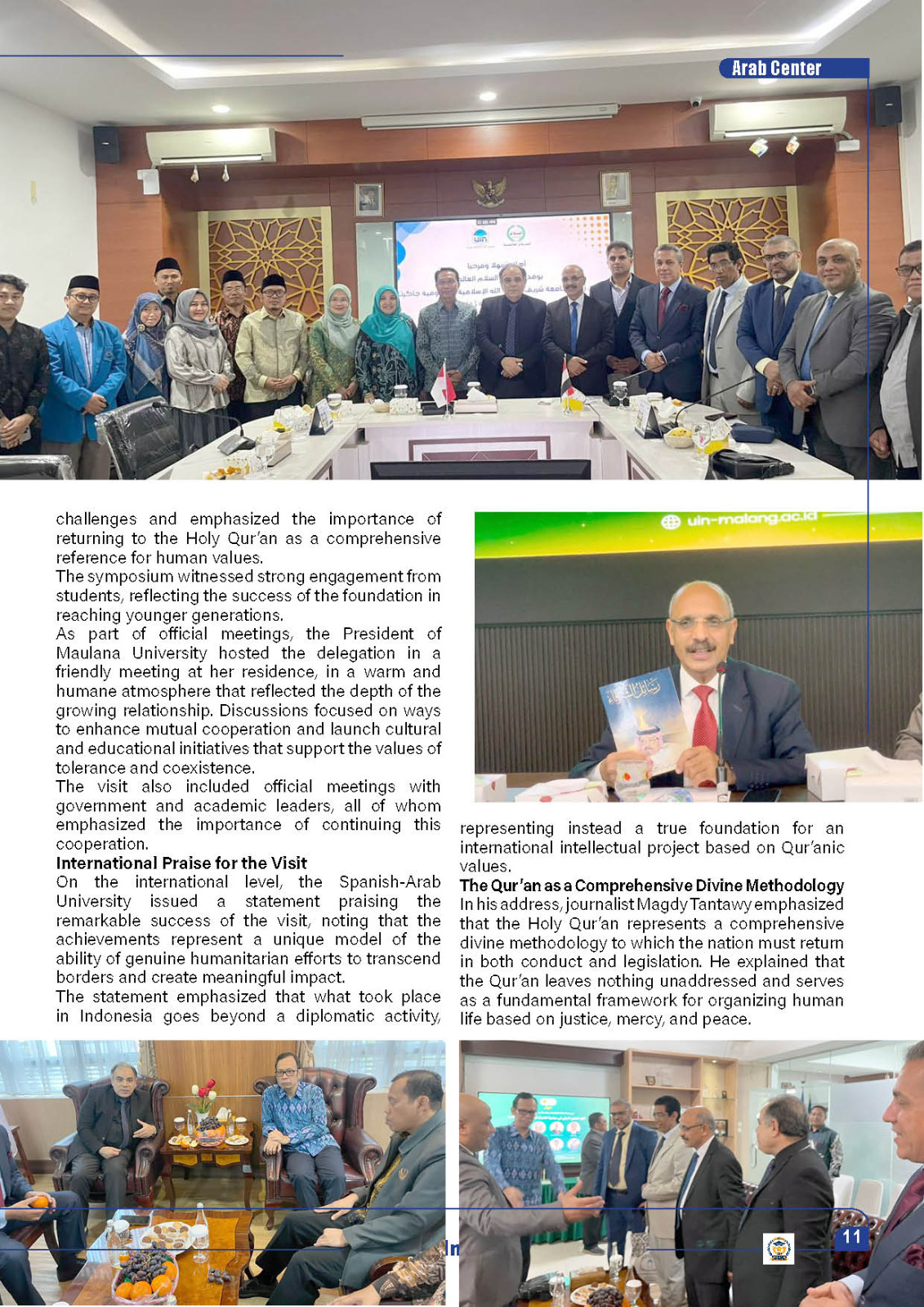
As part of official meetings, the President of Maulana University hosted the delegation in a friendly meeting at her residence, in a warm and humane atmosphere that reflected the depth of the growing relationship. Discussions focused on ways to enhance mutual cooperation and launch cultural and educational initiatives that support the values of tolerance and coexistence.
The visit also included official meetings with government and academic leaders, all of whom emphasized the importance of continuing this cooperation.
International Praise for the Visit
On the international level, the Spanish-Arab University issued a statement praising the remarkable success of the visit, noting that the achievements represent a unique model of the ability of genuine humanitarian efforts to transcend borders and create meaningful impact.
The statement emphasized that what took place in Indonesia goes beyond a diplomatic activity, representing instead a true foundation for an international intellectual project based on Qur’anic values.
The Qur’an as a Comprehensive Divine Methodology
In his address, journalist Magdy Tantawy emphasized that the Holy Qur’an represents a comprehensive divine methodology to which the nation must return in both conduct and legislation. He explained that the Qur’an leaves nothing unaddressed and serves as a fundamental framework for organizing human life based on justice, mercy, and peace.
Tantawy added that the foundation seeks to re-evaluate Islamic discourse in its real form away from distortions, stressing that Islam is a message of mercy, not conflict, and that its essence is rooted in love and good deeds. He criticized the focus on outward forms of religion, calling instead for translating values into practical behavior that reflects true faith.
In a related context, He also highlighted the importance of connecting new generations to the Qur’an through understanding and reflection, rather than mere memorization, noting that the newly established centre represents a practical step toward achieving this goal.
He concluded by emphasizing that true investment begins with “the People of the Qur’an,” calling for support for educational institutions that instill these values.
Arabic as the Vessel of the Qur’an
Dr. Abdelradi Radwan emphasized in his speech the importance of the Arabic language as the vessel of the Qur’an, noting that interest in it reflects a deep appreciation for Islamic cultural identity. He described Arabic as possessing a unique linguistic and rhetorical richness that places it among the world’s greatest languages, encouraging students to embrace it.
He added that the Qur’an serves as a guiding light for humanity toward paths of peace, with teachings that extend beyond spirituality to organizing human behavior according to moral values. He cited verses that highlight justice and excellence (Ihsan) as foundations for building societies.
He concluded by stressing that true excellence is not limited to academic achievement, but also includes commitment to values, urging students to embody Qur’anic ethics in their daily lives and praising their keenness and openness.
Media and Education as Pillars of Awareness
Dr. Reda Abdelsalam highlighted in his intervention the importance of integrating media and education in promoting cultural awareness, emphasizing that cultural diplomacy is an effective tool for building bridges between nations. He noted the vital role academic institutions can play in this context.
He further explained that contemporary challenges require a renewed religious discourse capable of addressing both intellect and spirit, while confronting extremism through logic and knowledge. He stressed that international cooperation in the educational field is essential in facing these challenges.
He concluded by affirming that the “Message of Peace” Foundation represents a practical model for integrating intellectual and educational roles, calling for its replication in other regions.
At the conclusion of the visit, the features of a new phase of cooperation became evident. The outcomes extended beyond agreements and events to the establishment of a network of human and institutional relationships with long-term impact.
This tour confirmed that a discourse rooted in the Holy Qur’an, when presented with openness and a humanitarian spirit, can resonate widely across diverse cultures.
The visit opens new horizons for spreading the true message of Islam in Asia and confirms that the “Message of Peace” is not bound by geography, but carries a universal character that enables it to contribute to contemporary global dialogue—especially in a world in need of restoring the values of mercy and coexistence.