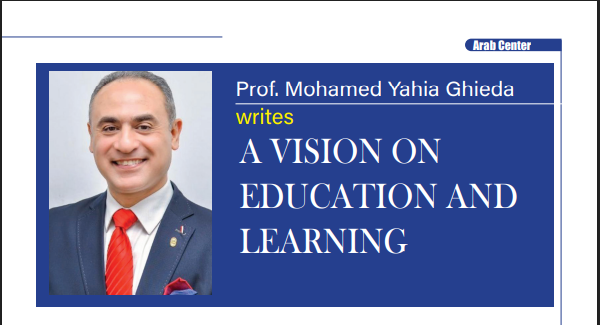
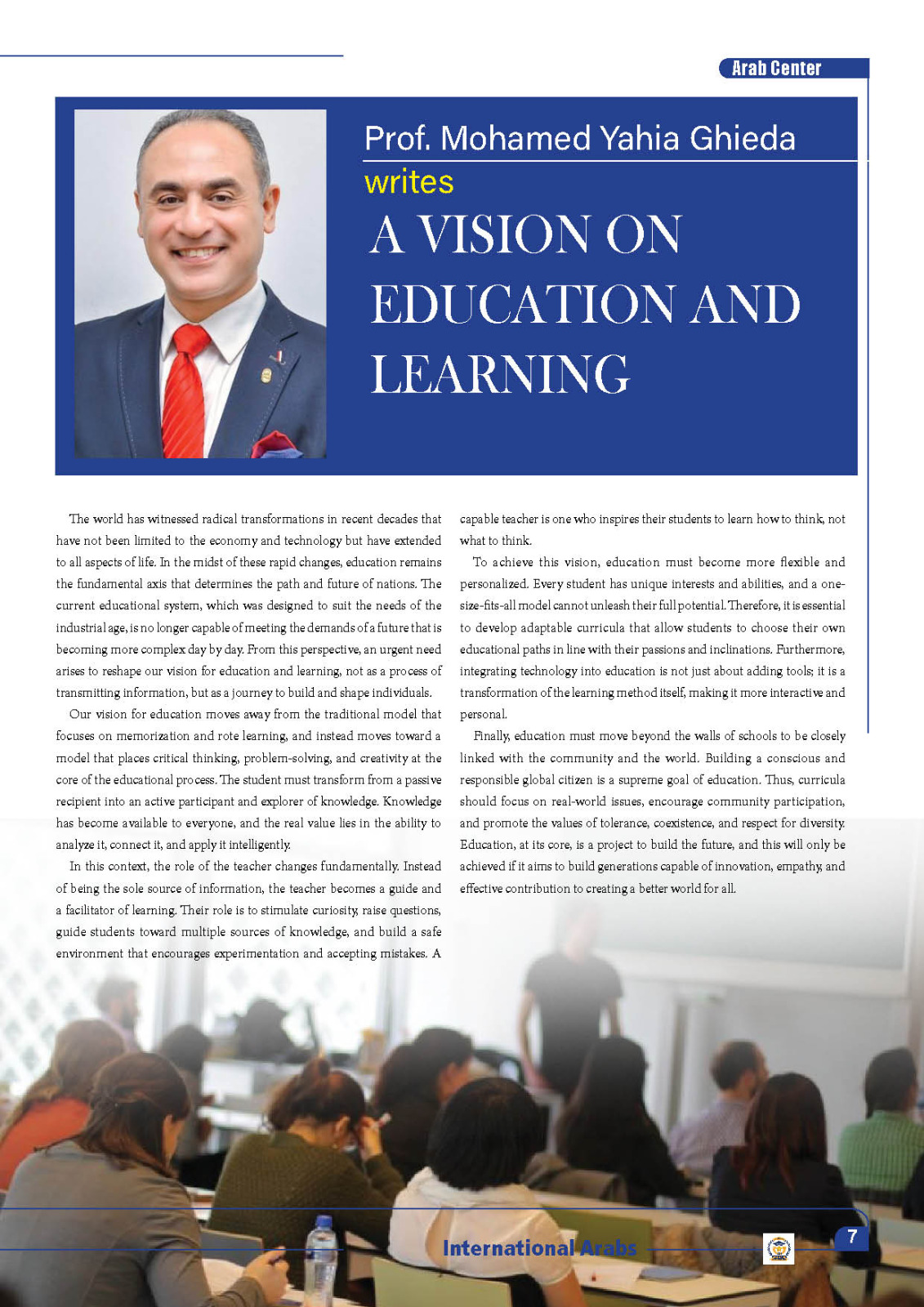
Dr. Mohamed Yahya Ghida Writes a Vision on Education and Learning
The world has witnessed radical transformations in recent decades that have not been limited to the economy and technology but have extended to all aspects of life. In the midst of these rapid changes, education remains the fundamental axis that determines the path and future of nations. The current educational system, which was designed to suit the needs of the industrial age, is no longer capable of meeting the demands of a future that is becoming more complex day by day. From this perspective, an urgent need arises to reshape our vision for education and learning, not as a process of transmitting information, but as a journey to build and shape individuals.
Our vision for education moves away from the traditional model that focuses on memorization and rote learning, and instead moves toward a model that places critical thinking, problem-solving, and creativity at the core of the educational process. The student must transform from a passive recipient into an active participant and explorer of knowledge. Knowledge has become available to everyone, and the real value lies in the ability to analyze it, connect it, and apply it intelligently.
In this context, the role of the teacher changes fundamentally. Instead of being the sole source of information, the teacher becomes a guide and a facilitator of learning. Their role is to stimulate curiosity, raise questions, guide students toward multiple sources of knowledge, and build a safe environment that encourages experimentation and accepting mistakes. A capable teacher is one who inspires their students to learn how to think, not what to think.
To achieve this vision, education must become more flexible and personalized. Every student has unique interests and abilities, and a one-size-fits-all model cannot unleash their full potential. Therefore, it is essential to develop adaptable curricula that allow students to choose their own educational paths in line with their passions and inclinations. Furthermore, integrating technology into education is not just about adding tools; it is a transformation of the learning method itself, making it more interactive and personal.
Finally, education must move beyond the walls of schools to be closely linked with the community and the world. Building a conscious and responsible global citizen is a supreme goal of education. Thus, curricula should focus on real-world issues, encourage community participation, and promote the values of tolerance, coexistence, and respect for diversity. Education, at its core, is a project to build the future, and this will only be achieved if it aims to build generations capable of innovation, empathy, and effective contribution to creating a better world for all.