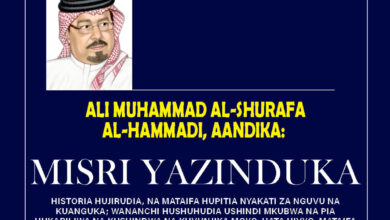
Ali Mohamed Elshorafa Elhamadi writes… The Seven Pillars to Achieve Unity and Arab Integration
Summary
In the editorial of edition No. 51 from Al Arab Magazine – April 2206, the great Arabian thinker Ali Mohamed Elshorafa Elhamadi presents a strategy to rebuild Arab integration with a comprehensive and applicable concept through seven pillars for the unity of the Arab nation politically, economically, socially, and militarily.
The study, which we present to the officials in the Arab countries, was previously presented specifically in 2001 to the Secretary-General of the Arab League, Mr. Amr Mousa, but it remained locked in drawers and was not applied.
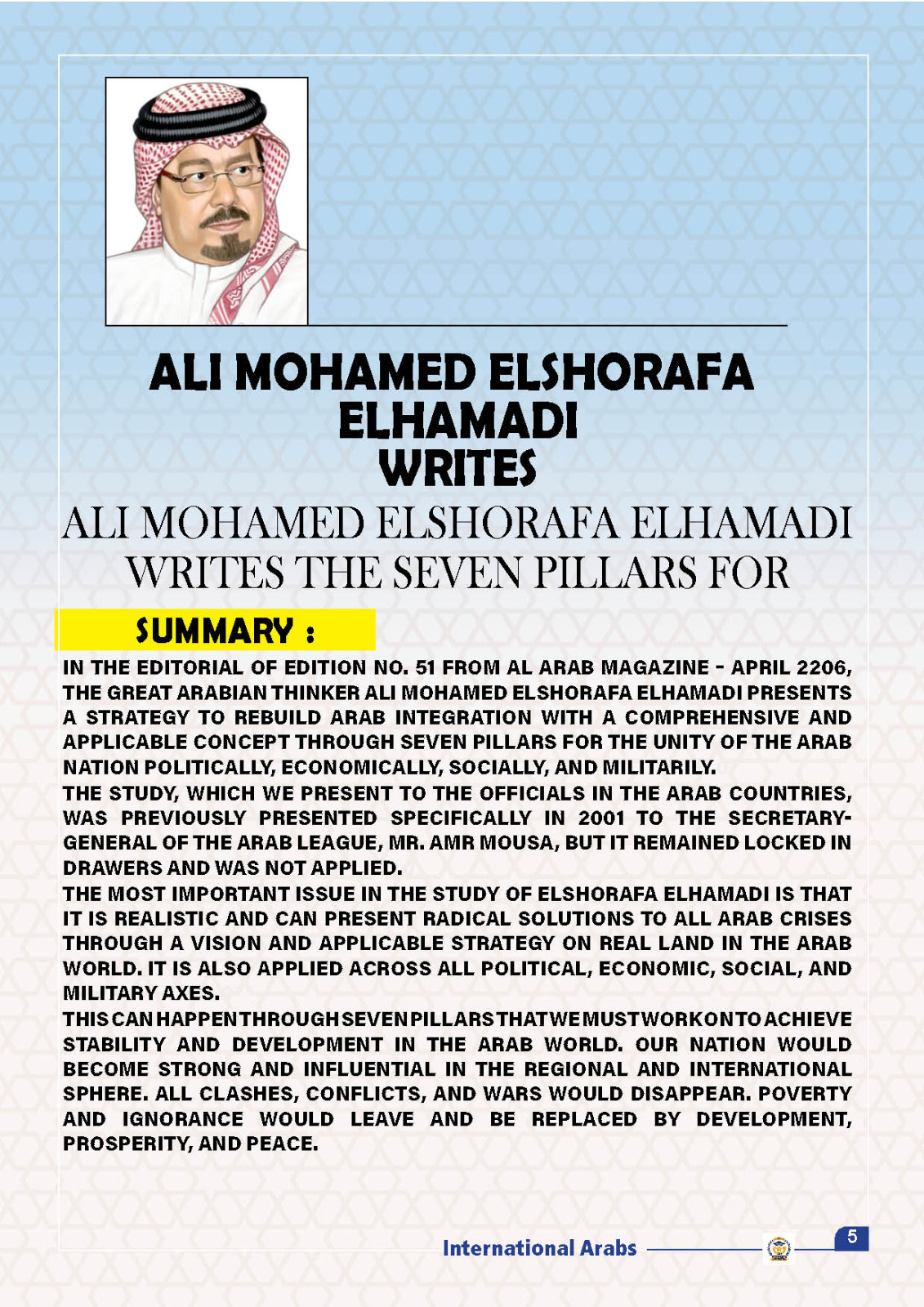
The most important issue in the study of Elshorafa Elhamadi is that it is realistic and can present radical solutions to all Arab crises through a vision and applicable strategy on real land in the Arab world. It is also applied across all political, economic, social, and military axes.
This can happen through seven pillars that we must work on to achieve stability and development in the Arab world. Our nation would become strong and influential in the regional and international sphere. All clashes, conflicts, and wars would disappear. Poverty and ignorance would leave and be replaced by development, prosperity, and peace.
The details of the study:
First Pillar: The Political Field
The File of Arab Rights and Duties:
We must put a new charter where Arab relations are defined in a clear and committed way, with a frank determination of the duties of each Arab country that guarantees its rights. It has its commitments in peacetime or in times of aggression by one of the countries outside the Arab group.
The Way of Ending Conflicts:
A framework must be established for dealing among the Arab countries through direct communication or continuous dialogue to end any conflict. This can be processed quickly, limiting the issue among leaders, preventing any repercussions that negatively reflect on nations and increase the refrain of this nation from its goals. This helps its enemies exploit any point of weakness.
Regular Meetings:
Arab countries are committed to regular meetings at the summit conferences at the headquarters of the Arab League. It is not allowed under any justification, pretext, or emergency to adjourn the summit meetings until the Arab countries prove the seriousness of the meetings and their results, which have a great effect on the interest of the Arab nation.
Modification of the Law of the Arab League:
Reconsideration of the Law of the Arab League is necessary to reactivate and restructure it so that it may have the capability to shoulder the responsibility of the new century.
It requires qualifications, potentials, and policies containing its requirements as follows:
- Appointing the Secretary-General is periodical according to alphabetical order on the basis of three years that are not renewed. The opportunity is provided to another Secretary-General according to the alphabetical order so each Arab country takes the opportunity in a way that ensures fair rotation for the Secretary-General.
Second Pillar: The Military Field
Establishing the Arab National Security Council should be formed from leaders of the Armed Forces in the Arab League, followed by a special secretariat headquartered at the Arab League. The National Council for Strategic and Military Planning takes responsibility for executing the following:
Activation of Joint Defense Pact: Putting the system and the guaranteed procedures to activate the Arab Joint Defense Pact, which is signed by all the Arab countries.
Communicating with Military Leaders: Coordinating with military leaders in the Arab countries.
Cooperation among the Armies: Arranging cooperation among the Armed Forces in the Arab countries by making annual maneuvers according to a prepared program, so that each team is able to know the weapons and capabilities of the other teams and unify military terms.
Planning and Execution: Putting necessary plans for any procedures that the national interest requires, whether defending any Arab country exposed to aggression or intervening to prevent any clash between two Arab countries, to avoid catastrophes like those of the last century.
Secretary-General of the National Security Council:
Appointing a General Secretariat for the National Security Council to conduct the responsibilities referred to above, preparing agendas for the council’s meetings, and preparing reports about the results of the council to send them to the Arab Defense Council to adopt resolutions and ratify them on a schedule to execute them.
The Way of the Choice:
Appointing the Secretary-General of the National Security Council is done by high-ranking officials. Each country nominates the Secretary-General according to the alphabetical order applied by the system of the Arab League, provided that the term does not exceed three years.
Third Pillar: The Economic Field
Economic Integration:
The reasons that led to the economic regression of most Arab countries are the non-existence of natural resources or the lack of technical employment, but the main reason is the non-existence of financial resources that can exploit its natural resources, whether they are petrol or different raw materials. If they have the financial resources, they would invest in these resources and achieve job opportunities and a decent life for their nations.
Exploitation of Arab Wealth:
Therefore, the next phase requires effective procedures and a scientific and objective perspective in activating the capabilities of Arab countries to exploit their wealth and financial surplus. This requires the following:
Arab Bank:
Establishing an Arab Bank with capital not less than $50 billion. Its role is correcting financial structures in the Arab countries and developing their economic capabilities until they get rid of the economic crisis, on the basis of a five-year plan that considers countries with capabilities and wealth that can be invested to achieve economic results within five years. The performance of the bank and its executive policy depends on economic studies. Consequently, it can address financial dysfunction sequentially in the Arab countries. This means that if the Arab nation could put general scientific mechanisms and devote the financial surplus for the Arab economy, it will achieve the following:
Benefits of Economic Integration:
- Arab investments will be safe from freezing, confiscation, or manipulation, like what happened in many examples everyone knows, such as when the United States of America froze the balances of Libya.
- The financial return on Arab investment will be guaranteed and will exceed what Arab investments obtain in Western countries from low interest and sometimes loss of capital in international investments.
- Ownership of Arab investments for real productive projects, whose markets exist in Arab countries. For example, Arab countries import annually more than $65 billion in food; this money can be redirected to Arab products and would be a factor for the prosperity of productive Arab societies.
- Arab countries facing financial hardships in financing their natural resources will achieve great benefits in developing their wealth, achieving development goals, and providing job opportunities. This helps stability and growth, prevents political instability and military coups, eliminates dependence on foreign aid, preserves dignity, and supports building a bright future.
Economic Studies Bureau:
Establishing an economic studies bureau to examine economic situations and prepare scientific plans on how to exploit the natural resources in each country before approving financial support.
Sudan as the Source of Arab Food:
For example, Sudan provides 200 million feddans viable for agriculture, capable of providing the Arab world with food and achieving food security. The suggested bank can prepare ambitious projects to exploit Sudan, providing economic benefits, solving financial problems, and providing tens of thousands of jobs. This turns the Sudanese population into a productive force.
Fourth Pillar: Facing Economic Globalization
Economic Conflict:
Due to subsequent economic development in our current era and the end of conflicts between Eastern and Western power camps, these developments have imposed a new type of clash; we call this the economic conflict. In my opinion, it is the fiercest and most dangerous conflict in the present and future, as it is represented by the clash of economic capabilities, planning potential, and marketing styles, mainly depending on production quality, competitive pricing, speed, flexibility, and adaptation to market requirements, with ethics and new values, reaching the main goal of delivering the largest possible production to new markets.
Competition and Product Invasion:
The GATT agreement will open a wide domain for competition and infinite product invasion, giving freedom to the market where supply and demand are the main mechanisms. This must be taken seriously, as sovereignty will favor the strong while the weak regress. Markets will consume, causing dangerous burdens such as unemployment.
Employing Economic Powers:
It is necessary to prepare a future plan containing all economic powers and employ them scientifically, with an inclusive view of all societal sectors. Otherwise, society risks fragmentation, regression to narrow individual or family interests, and loss of collective development efforts and the catastrophe starts. Therefore, it requires establishing the Arab Company for Marketing as follows:
Axes of Arab Collaboration:
The company is formed with capital not less than $5 billion, 50% from Arab governments and 50% from businessmen in Arab countries.
Mission:
- Developing commercial exchange among Arab countries.
- Exploring common projects in different economic sectors and facilitating the flow of Arab money.
- Helping find new markets to sell products made in Arab countries.
- Preparing studies and providing necessary data for commercial, industrial, agricultural, and investment matters.
- Facilitating difficulties in transferring goods among Arab countries.
- Examining investment opportunities and directing Arab financial surpluses to infrastructure projects for higher returns than investments outside the Arab world, while solving infrastructure problems.
3- Forming a board of directors representing governmental and private sectors to plan and achieve these goals. Four branches will be established, with the main headquarters in Jeddah, Saudi Arabia. Other branches in Morocco, Cairo, Beirut, and Dubai.
Fifthly: The Credibility of Arab Slogans
Media and the Unity of the Arab Nation:
It is necessary to create a logical and rational climate for reconciliation with ourselves and eradicate the contradictions that every Arab citizen experiences in any Arab country. This is the result of what the Arab countries tackle in official meetings and the media apparatus, with permanent assurance of the unity of the Arab nation, its destiny, and its economy.
The Arab citizen sees in daily life a dangerous contradiction in behavior and practices that, through legislation, laws, and regulations of each country, affirm regionalism and practice sectarian discrimination among Arabs living in any Arab country. This behavior contradicts what the Arab countries announce and what their constitutions stipulate, which is that they are part of the Arab nation. The unity of destiny, language, geography, and interests gathers us. Without action, Arabism remains merely in the imagination of dreamers for some Arab citizens.
From this perspective, if the Arab nation wants to face the new century and prepare for it, like Europe, which fixed its eyes on clear goals where mutual security and economic integration come above narrow regional selfishness, it can become a formidable power if united. It can achieve stability, increase the economy, and develop progress. This is the aspiration of every patriotic Arab for the future of his nation. We shall place national interest above all considerations, ensuring that all people achieve security and stability, and we can build a bright future for Arab generations.
Sixthly: The Arab Common Market
The Strategy of the Arab Common Market:
It is necessary to put a strategy for the Arab Common Market by establishing mechanisms where the public and private sectors in Arab countries participate to achieve trade movement among Arab countries and exploit all financial, technical, and economic powers. The Arab Common Market must have the following:
- Forming a board of directors of the Market from the Ministries of Economy in the Arab world and the presidents of the Commerce Chambers. Each country nominates three representatives from the most important public sector companies and three representatives from the most important private sector companies.
- Appointing a General Secretariat for the Market, choosing Dubai in the UAE as the center because of its geographical position, its development, specialized expertise for commerce and communication, its status as an international exhibition center, and its infrastructure for exporting to different countries. The Dubai government prioritizes economic movement, openness to the world, and provides support to develop its international economic prestige.
- The board of directors meets every three months to prepare all organizations and regulations.
- Coordination among all navigation companies and other transportation means to serve economic and marketing movement among Arab countries.
- Following officials in Arab countries to ensure that economic agreements among Arab countries are applied.
- Facilitating all obstacles for the passage of goods among Arab countries.
- Employing approved credit lines by the Arab Monetary Fund to cover intra-trade and operate them among Arab countries.
- Reporting every six months to the Council of the Common Market on achievements and tackling problems to make practical decisions to solve them.
- Putting systems and laws to give sufficient guarantees to Arab investors.
Seventhly: Build a Nation
Firstly: The National Project
- Forming a teamwork from the Ministries of Education, Economy, Social Affairs, Media, Foreign Affairs, and Justice, along with three members from the Arab Parliament from each country. They will prepare a strategy to visualize a national project for the Arab nation, combining the following features:
- Preparing a new main project for relations among Arab countries and communication among them to achieve unity in political stance and entrench the concept of the nation and common destiny.
- Drafting a Code of Honor project, committed to by Arab countries, defining ways of communication among them to achieve unity and mutual destiny. Modern mechanisms like a network of special communication will enable Arab leaders to communicate directly and exchange views in any emerging situation, preventing negative repercussions and fostering unified solutions in the interest of the Arab nation.
- Liberating Arab citizens from fear or anxiety to secure life, honor, and livelihood. Citizens will not be arbitrarily arrested, have their money confiscated, or have their freedom restricted unless they commit a crime and a judgment is issued by competent courts. Legal rules will protect citizens, preserve dignity, protect rights, and allow freedom of expression without aggression toward religion, people, or society. Citizens may express their convictions and provide sincere advice to serve their country. It alerts to the mistakes and dangers that threaten the security of his society, and emphasizes that this behavior is a divine legislation affirmed by the Qur’anic verse.”And let there be among you a community calling to virtue, advocating righteousness, and deterring from evil.”
Through such behavior, society can address mistakes early, allowing sincere individuals to highlight shortcomings and prevent negative consequences . . In this way, Arab societies can adjust themselves and correct their errors. When security and safety prevail, devoted talents and upright citizens will lead, offering practical solutions for social problems.
- The committee shall prepare a draft decision to abolish visas between Arab countries, aligning with Arab countries’ declarations, reflecting their commitments, and embodying the belief that we are one Arab nation with a shared destiny. This will affirm Arab unity, exchange interests among peoples, and enable transfer of surplus labor to countries lacking workforce. This will activate economic activity and preserve the Arab character of countries where non-Arab labor threatens national security, identity, and cultural heritage.
Arab leaderships must commit firmly to refrain from taking unilateral positions in foreign policy, as such behavior previously hindered Arab goals and increased fragmentation. The principle of consultation among Arab countries, with the Arab League playing a positive coordinating role after reorganizing its laws, will mobilize energies in service of national objectives.
Secondly: Arab Disagreements
One major cause of disagreements among Arab countries is border issues, inherited from occupations before Arab independence. These have caused destructive wars and loss of progress and cooperation opportunities until The mentality of Dahis and Ghabra and the Basus War continues to influence behavior and daily practices in dealing with each other. To solve this dilemma, the following procedures must be taken:
- Formation of an Arab Court of Justice:
An Arab country shall host its headquarters, with judges nominated by each Arab country. Five judges are appointed by lottery from nominated candidates, with re-nomination every five years.
- Jurisdiction of the Court:
The court shall consider all disputes between concerned Arab countries and submit rulings to the Arab League Council for ratification. The ruling shall be binding, and countries must implement it immediately.
2- Arab leaders at all levels must undertake sincere self-reflection: Where are we headed? Reviewing the past fifty years of the Arab League’s existence—what has been achieved? May God aid our political leadership to answer before it is too late. Palestine remains a vivid reality that pains the heart; failure to learn from history leads to tragedy.
As stated in the Qur’anic verse:
“And if two groups of believers fight, make peace between them. But if one oppresses the other, fight the one who oppresses until it returns to God’s command. Then reconcile them with justice, for God loves the just. The believers are but brothers, so reconcile between your brothers and fear God that you may receive mercy.”
This verse should serve as a fundamental principle that the Arab League adheres to, and that Arab countries whose constitutions declare Islam as the official religion fully implement God’s law for the supreme interest of the Arab Muslim nation.
In Conclusion:
We affirm that the unity of the Arab nation is the source of its strength, growth, and stability, which is the
ultimate goal we seek.