Sadat Academy…Education copes with the labor market and graded opportunities from undergraduate to postgraduate studies
The choice of university specialization is no longer a separate decision from the student’s professional future, in light of a rapidly changing labor market due to digital transformation, artificial intelligence, the expansion of the private sector, projects and entrepreneurship. In this context, during August 2026, the Sadat Academy for Administrative Sciences witnessed a set of educational activities, events and announcements that reflected a clear trend towards linking education to the needs of the labor market, and expanding the options available to students and graduates, whether through bachelor’s and bachelor’s programs or through graduate and professional programs.
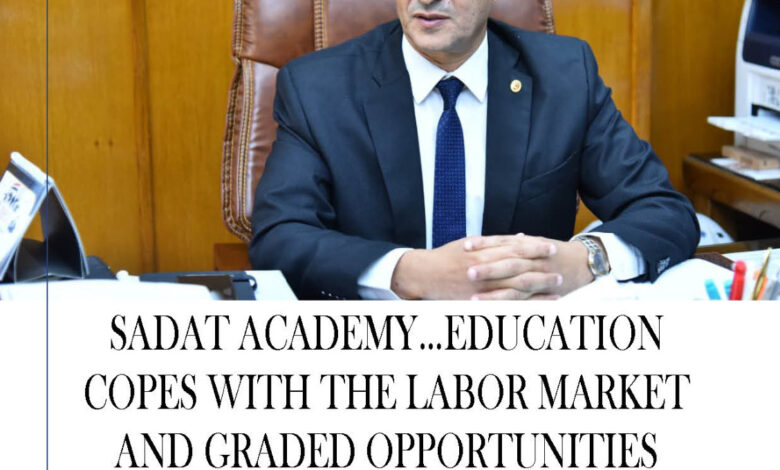
This comes in parallel with the Sadat Academy’s vision to develop its educational programs continuously, as Prof. Mohammed Saleh Hashim, President of the Academy, explained that the student’s choice of specialization that corresponds to his abilities and tendencies represents one of the most important keys to success, calling for moving beyond the traditional concept of “top colleges” and paying attention to the disciplines needed by the labor market.
The labor market is changing. Digital skills have become a necessity
The head of the academy stressed that technological transformations do not necessarily mean the disappearance of traditional professions, but rather the change in the nature of their performance, pointing out that artificial intelligence, data analysis, software, cybersecurity and other fields have become an essential part of the jobs of the future. He also stressed the need for students and graduates to continue learning and training and not just obtain a university degree.
In a television interview in August, Dr. Mohammed Saleh Hashem spoke about the future of jobs and the impact of artificial intelligence and technology on the labor market, stressing that the private sector and small and micro enterprises will play an increasing role in providing job opportunities in the future.
He pointed out that technology will lead to the disappearance or decline of some jobs, but in return it will create new jobs related to data analysis, software, artificial intelligence and cybersecurity, which makes possessing digital skills a necessity and not just an additional advantage.
In this context, the Academy offers more than 150 programs in the fields of administrative sciences, computers and information, artificial intelligence, cybersecurity, data analysis and e-marketing, along with languages and translation, with specialized programs in hospital management, sports management, medical insurance management, local administration and others.
From Education to Future Opportunities
The activities of the Academy during August 2026 revealed a parallel movement in more than one direction. In addition to the continuation of student activities, the month witnessed an intensification of the introduction of educational programs and the reception of new students, the opening and continuation of admission in a number of specializations, as well as the participation of the Academy’s students in technical competitions, and a review of the Department’s vision for future jobs.
One of the most prominent events of the month was the participation of students of the Faculty of Computing and Information in the ICPC global programming competition held at the Arab Academy for Science, Technology and Maritime Transport in Alexandria on August 18, where two teams of students from the Academy qualified for the ECPC final. This attendance reflects a trend towards transforming the study of computers and software into a competitive practice that allows students to test their skills outside the traditional academic framework.
August also witnessed the continuation of application for graduate programs at the Faculty of Administrative Sciences, in parallel with the opening and continuation of admission to bachelor’s and bachelor’s programs. The announcements included disciplines in computing, data analysis, programming and software development, which are directly related to digital transformation and new technological functions.
On August 17, the Academy offered opportunities to join the specialization of data analysis at the Faculty of Computing and Information, with a focus on data mining, programmatic statistics, and data visualization. It also announced the specialization of programming and software development, including web and mobile application development, software engineering, and systems testing. (
In a parallel direction, the Academy announced during the month the continuation of admission to the Faculty of Languages and Translation, which opens for students an academic and professional path in the field of languages, while the Academy originally provides a path for graduate studies in English translation.
International quality.. Developing the educational and administrative environment
Recent weeks have also witnessed Sadat Academy receiving the international quality certificates “ISO 9001:2015” and “ISO 21001”, in a move that reflects a trend towards developing the management system, education and services provided to students and beneficiaries.
ISO 9001:2015 certification is concerned with quality management systems, while ISO 21001 is related to the management systems of educational institutions, which reflects a trend towards the application of institutional standards in management, the educational process and continuous improvement. According to the available data, the validity of the ISO 9001:2015 certificate began on July 27, 2026 and continues until July 27, 2029, subject to periodic follow-up reviews.
The importance of this step does not stop when obtaining an accreditation certificate, but extends to improving educational and administrative services and processes, which is directly reflected in the experience of the student, the student and the graduate.
Three Education Pathways and Extended Graduate Opportunities
The Academy is characterized by the presence of three main colleges in the tracks offered, the College of Administrative Sciences, the College of Computers and Information, and the College of Languages and Translation. These colleges offer various options starting from bachelor’s and bachelor’s degrees and extending to master’s, doctorate and diplomas as follows.
Undergraduate stage
The College of Administrative Sciences grants a bachelor’s degree through the English and Arabic Divisions.
A – Bachelor of Administrative Sciences – English Language Division
It has three specializations:
- International Business Management.
- Business Information Systems (bis).
- Accounting and Finance.
B – Bachelor of Administrative Sciences – Arabic Language Division
Business Administration
It includes four tracks:
- Funding and investment
- Marketing and E-Commerce
- Banking Management
- Petroleum and Energy Facilities Management Pathway.
In addition to :
- Human resources management
- Management Information Systems
- Economy
- Accounting:
- Public and local administration.
- Actuarial science.
This diversity reflects a trend towards not limiting administrative sciences to the concept of “business management” in its traditional sense, but rather dividing them into disciplines and paths related to different economic and professional sectors.
Faculty of Computers and Information Disciplines most relevant to digital transformation
The Faculty of Computing and Information Technology grants a bachelor’s degree in a range of technological disciplines, namely:
- Computer Science.
- Information systems
- Software Engineering.
- Artificial Intelligence
- Cyber Security.
- Data Science.
The importance of this group is highlighted in its direct association with digital transformation and new technological functions.
This trend was clearly demonstrated in August activities, with college students participating in programming competitions, and introducing the disciplines of data analysis, programming and software development to students wishing to enroll in the academic year 2026/2027.
And it’s not just the academic aspect; the disciplines themselves open up different paths for the graduate, from software and information systems development to artificial intelligence, data science, and cybersecurity.
College of Languages and Translation Four language pathways
The Faculty of Languages and Translation grants a bachelor’s degree in four linguistic disciplines:
- English
- Chinese
- Spanish
- Russian
This diversity gives the student the opportunity to choose a language that corresponds to his interests and professional ambition, with the possibility of later completing the study in the field of translation through the graduate programs available at the Academy.
Why is the Academy an opportunity for graduates?
The map of educational programs and activities witnessed by the Academy during August reveals a model that does not treat graduation as the end of the educational journey, but rather as a stage on which to build.
A graduate in management sciences can move to precise specializations in finance, investment, marketing, human resources, accounting and auditing, information systems, healthy management, sports management, supply chains, logistics, and others.
The computer and information graduate is in front of a range of fields that are directly related to digital transformation, such as artificial intelligence, data science, cybersecurity, software engineering and information systems.
As for the graduate of languages and translation, he can build an academic and professional path that starts from studying language and then extends to translation and postgraduate studies.
Here, an important point emerges in the philosophy of the Academy. Its president stressed that obtaining a university degree alone is no longer sufficient in the changing labor market, and that the student and the graduate need to continue learning, training and building skills.
He also stressed that the Academy does not focus only on education, but also works in training and preparing leaders, and provides training programs for workers in government and private institutions in cooperation with ministries, governorates, unions and various institutions.
The circle of benefiting from these disciplines is expanding because the fields covered by the Academy are linked to multiple economic and institutional sectors.
The disciplines of management, finance, accounting, human resources, and marketing can be associated with business enterprises, banks, corporations, the health sector, and government and non-profit organizations.
Computing and information disciplines are related to software, data analysis, cybersecurity, artificial intelligence and information systems, which are increasingly important areas with digital transformation.
In the field of languages, studying English, Chinese, Spanish, and Russian can form the basis for multiple career paths, especially when combining language and translation, management, or technology skills.